Serbia slips into open backsliding: authorities dismantle even past reform gains


PrEUgovor Alarm report on the progress of Serbia in Cluster 1 – May 2026 is published and presented
Serbia moved visibly further away from its goal of European Union membership, slipping from stagnation into open backsliding. It is no longer merely a matter of the authorities persistently refusing to fully implement priority reform measures, but of actively dismantling what had previously been praised — albeit imperfect — as a success, such as judicial reform. In order to preserve political control over institutions that had begun to perform their duties despite mounting pressure, the authorities clumsily abandoned the previous simulation of reform efforts and good intentions. This simulation was then revived at full speed through the establishment of new bodies and mechanisms and the drafting of numerous long-overdue regulations. At the same time, the space for public participation in the drafting of legislation and public policies has been systematically narrowed, both normatively and in practice, with this trend paradoxically being formally justified by the need to accelerate reforms within the framework of the European Union accession process.
The Report in full is available HERE.
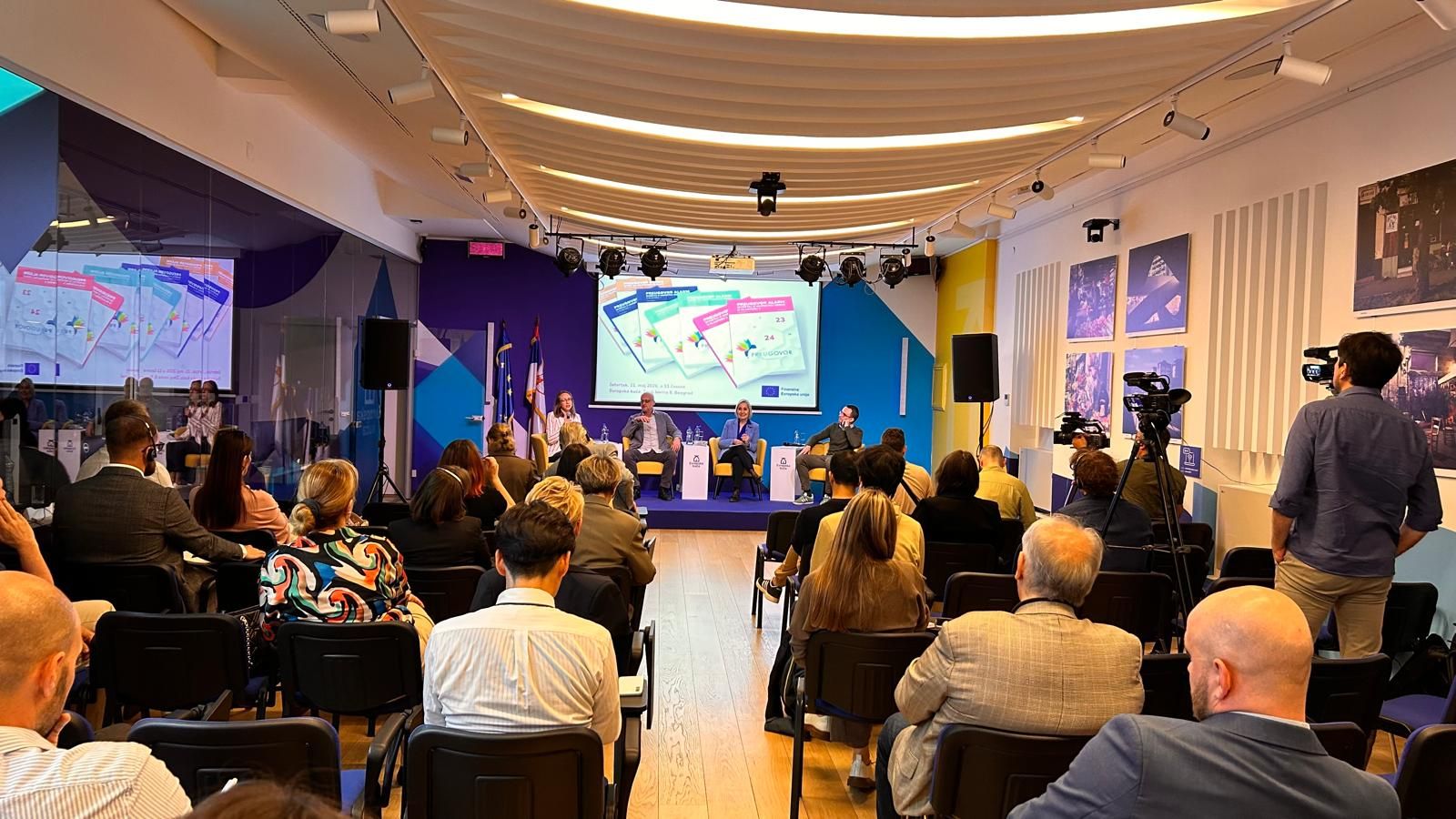
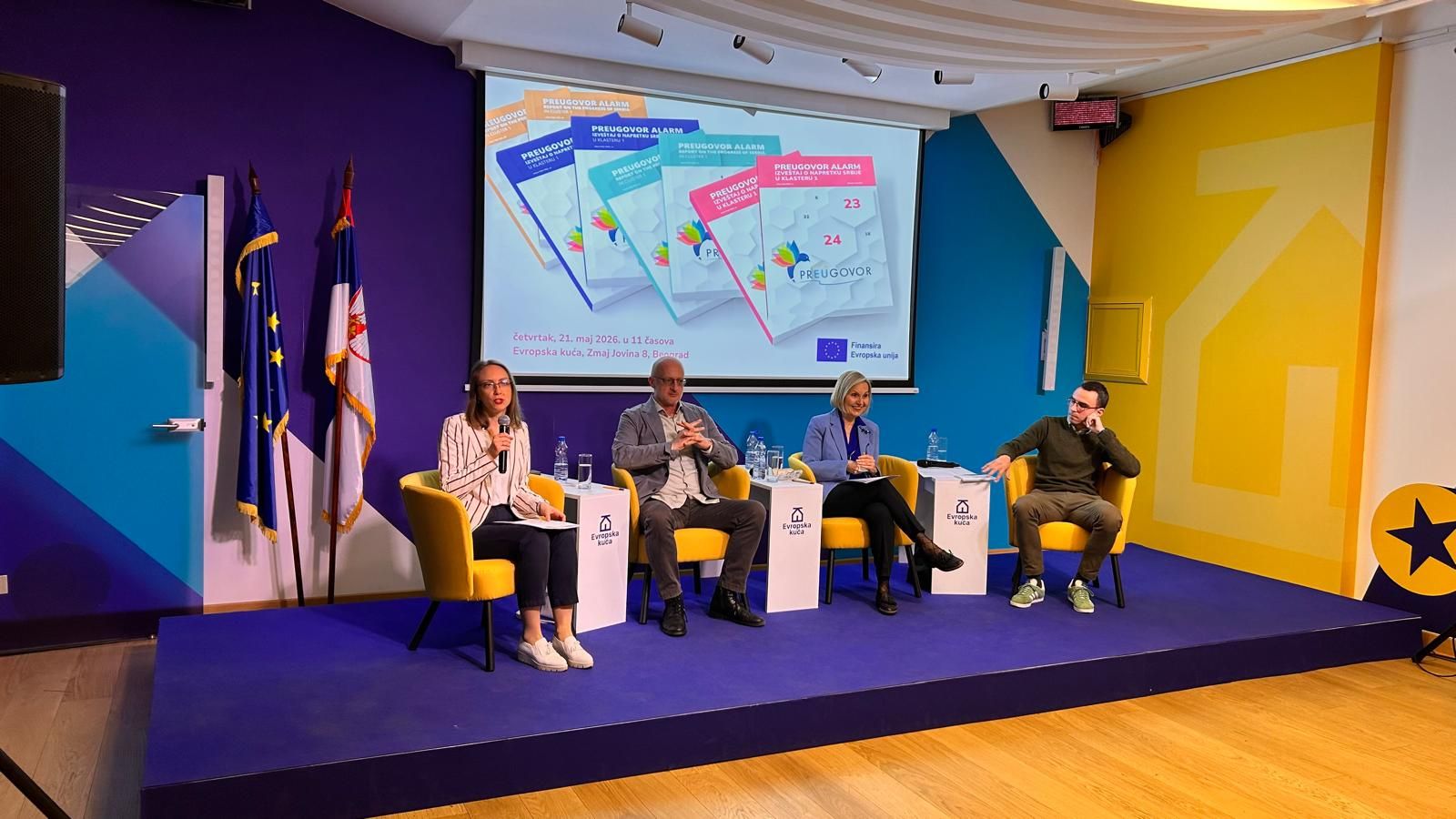 At a panel held at the European House during the presentation of the Alarm Report on Cluster 1, participants concluded that laws are being adopted without meaningful public debate, without consultations with relevant institutions, and without genuine alignment with European standards.
Jelena Pejić Nikić from the Belgrade Centre for Security Policy (BCSP), editor of the report and moderator of the panel, stated that Serbia has begun to reverse reforms that had previously been adopted, pointing in particular to the latest judicial laws.
She assessed that laws are currently being adopted in Serbia that are not aligned with recommendations, international agreements, and European standards. According to her, this may also affect the absence of positive news from Brussels, especially regarding the disbursement of funds from the Growth Plan for the Western Balkans. Pejić Nikić welcomed the EU’s sharper responses to negative developments in the country, while highlighting Serbia’s operational membership in the Single Euro Payments Area (SEPA) as of May this year as a rare positive event.
Authorities Move to Shut the Public Out of Lawmaking
Nemanja Nenadić from Transparency Serbia emphasized that the authorities, under the pretext of accelerating the fulfillment of obligations arising from the European integration process, are adopting regulations without prior analysis and consultations. “The authorities are doing everything to completely exclude the public from consultations and from the process of fulfilling obligations from the Reform Agenda, while preventing access to planning documents, and EU institutions and member states should react to this,” Nenadić said.
The panel also addressed electoral conditions, which were assessed as deteriorating despite the recommendations of OSCE Office for Democratic Institutions and Human Rights (ODIHR). Participants stated that the authorities adopt only those recommendations that do not affect key mechanisms of political control.
Speaking about the financing of election campaigns, Nenadić assessed that the proposed limits are excessively high and further contribute to inequality among political actors. This was particularly evident in the recent local elections, where the ruling party’s reported campaign expenses were between 10 and 50 times higher than those of its competitors, he explained.
Escalating Hate Speech and Political Discrimination
Tanja Ignjatović from the Autonomous Women’s Center assessed that public debates are being concealed from the public and carried out only formally. “The working group for the amendments to the Family Law met only once, and the draft was presented immediately afterward, which indicates that the discussion was not genuine. There was no time for comments to be considered,” Ignjatović stated. She added that although the number of femicides decreased in 2025, it is particularly concerning that the proportion of cases in which violence had previously been reported increased, indicating that institutions are still failing to respond adequately.
The report also points to violations of human rights and a decline in the protection of civil liberties. Ignjatović assessed that hate speech in the public sphere is intensifying, particularly in pro-government media outlets, while pressure on people expressing political opinions is becoming increasingly frequent.
Police Brutality Goes Unpunished — and Is Rewarded
Miloš Jovanović from the Belgrade Centre for Security Policy spoke about the third Draft Law on Internal Affairs, assessing that it further entrenches the politicisation of the police and weakens democratic civilian oversight of its work, to the detriment of human rights and freedoms. He added that BCSP had submitted 48 comments on the Draft Law, of which only six were accepted and five partially accepted — only those preserving more precise wording from the current law. Jovanović assessed that personnel changes within the police demonstrate that it is becoming increasingly subordinated to political rather than public interests.
Jovanović also referred to cases of police brutality, assessing that they most often go unpunished. The report also covers police conduct during protests, local elections and raids on university faculties. “Serbia lacks a strategy for combating organized crime, while prosecutors working on sensitive cases are exposed to pressure and obstruction,” he added, with particular reference to the harmful consequences of the so-called “Mrdić Laws”.
The participants of the panel concluded that the authorities in Serbia do not demonstrate genuine political will to fulfill EU recommendations, but instead seek to create an illusion of progress while avoiding transparency, public debate, and the harmonization of laws with European standards.
The article was prepared by BCSP intern Teodora Podunavac.
News
The transformation of public enterprises did not bring an increase in transparency
The transformation of public companies into joint-stock companies and limited liability companies did not bring an increase in transparency, according to research conducted by Transparency Serbia. The PETRA 2026 survey included 34 state-owned enterprises that were evaluated and ranked based on 30 indicators. The average score is 42.1% (out of the…
... detaljnije ...Plans for Promotional Activities Have Rendered the Ban on Official-Holder Campaigning Meaningless
Official-holder campaigning in Serbia has neither been restricted nor prevented, as the recent amendments to the Law on the Prevention of Corruption have merely created the appearance that this area is regulated. Transparency Serbia’s monitoring shows that official-holder campaigning continues unabated through promotional activities. In most cases, officials have legal cover under…
... detaljnije ...Extended Incumbent’s Campaign
Nemanja Nenadić for CorD magazine The outcome of the election and the acceptance of results by participants remain uncertain. Legitimacy can be threatened by the bribing or blackmailing of voters (with the provision of evidence that they voted in a certain way), but mostly by the passivity of the police in…
... detaljnije ...Average LTI 2026 still 52 points — Novi Pazar shares the top with Veliko Gradište
The local self-government transparency index LTI 2026 remained at relatively low level 52 out of a possible 100 points. After several years of continuous growth, the average rating has now stagnated at the same level for the fourth year in a row, according to the survey Local Transparency Index -…
... detaljnije ...Elections to Be Held Under Worse Conditions Than in 2023
The elections, announced for 25 October, will be held under significantly worse conditions than those in 2023, despite several amendments to laws relevant to the electoral process. With regard to some of the key ODIHR recommendations, there has been no attempt whatsoever to introduce changes, either to the legislation or to…
... detaljnije ...Illegal Procurement Procedure for Voting Booths
Transparency Serbia has submitted an initiative to the Public Procurement Office to determine whether the Republic Electoral Commission violated the law in procuring voting booths. TS pointed out that the public procurement procedure was initiated even though it was not included in the annual procurement plan, and there are no grounds…
... detaljnije ...GRECO confirmed that recommendations have not been fulfilled
It is alarming that Serbia has fulfilled only three of the 24 GRECO recommendations for combating corruption in the executive branch and the police, even though the deadline expired almost three years ago (30 September 2023). Not only have laws that would contribute to fulfilling the recommendations not been adopted…
... detaljnije ...ODIHR Opinion Confirms That the Debate on the Proposed Amendments to the Law on Financing Political Activities Is Premature
The proposed amendments to the Law on Financing Political Activities do not meet some of ODIHR’s key recommendations, according to Transparency Serbia1, and this assessment has now been confirmed in the ODIHR opinion published today2. Since it is evident that the authorities will need to amend and supplement the proposal…
... detaljnije ...Serbia slips into open backsliding: authorities dismantle even past reform gains
PrEUgovor Alarm report on the progress of Serbia in Cluster 1 – May 2026 is published and presented Serbia moved visibly further away from its goal of European Union membership, slipping from stagnation into open backsliding. It is no longer merely a matter of the authorities persistently refusing to fully implement…
... detaljnije ...ODIHR Confirms: Stronger Oversight and Credible Sanctions Needed for Election Campaign Financing
The draft amendments to the Law on Financing Political Activities, on which ODIHR issued an opinion, failed to address some of the key recommendations. These include measures that would ensure stronger oversight and appropriate sanctions. Many of the shortcomings identified by ODIHR could be remedied if the law were amended…
... detaljnije ...
Agency Decisions on TS Complaints Regarding Violations of Campaign Regulations
The Agency for Prevention of Corruption has issued decisions on some of the complaints submitted by Transparency Serbia due to suspicions that political actors, as well as national and local officials, violated regulations during the local election campaigns in ten cities and municipalities. All cases in which decisions were made relate…
... detaljnije ...What is(not) visible from the preliminary campaign expenditure reports
Although all candidate lists for municipal assemblies in the ten municipalities were required to submit preliminary campaign expenditure reports by March 20, only slightly more than half (26 out of 49), according to the data published by the Anti-Corruption Agency, have fulfilled this obligation. Transparency Serbia advocates for a change…
... detaljnije ...Budgetary financing of campaigns – modest amounts, not planned in time
Of the ten cities, municipalities, and city municipalities where regular elections will be held on March 29, 2026, only Knjaževac clearly indicated how much it will allocate for financing the election campaign, while Sevojno is the only municipality that has calculated the total allocations for party financing during the budget…
... detaljnije ...Open Budget Index: Limited Transparency in Serbia
Serbia is among the countries where budget transparency is assessed as “limited,” scoring 53 out of a possible 100 points in the international Open Budget Index (OBI) survey, Transparency Serbia announced. Serbia has improved by two points compared to the previous round of this survey, which is conducted every two years. Of…
... detaljnije ...Corruption Perceptions Index 2025: Serbia scores worst in the past two decades
In the ranking of countries and territories by the Corruption Perceptions Index (CPI), Serbia, with a score of 33 and 116th place, has further worsened its result and, for the first time, is ranked the worst in the region. Serbia’s index is two points lower than last year and the lowest…
... detaljnije ...Harmful consequences of changes in judicial regulations on the fight against corruption
Changes to judicial regulations will likely reduce the possibilities of the Prosecutor's Office for Organized Crime to investigate possible corruption of high-ranking public officials. The consequences of the legal changes are even more harmful because the performance in prosecuting "high corruption" has not been satisfactory until now, and all of…
... detaljnije ...Urgent Amendments to Judicial Laws – Bypassing the Profession and European Standards and Amounting to Political Retaliation for “Disobedience”
The Working Group of the National Convention on the European Union for Chapter 23 warns the public about the serious risks posed by the scheduling of an extraordinary session of the National Assembly for 14 January, at which amendments to systemic judicial laws will be considered under an urgent procedure.[1]…
... detaljnije ...Fewer state-owned enterprises have a legal director
Of the 34 state-owned enterprises, regardless of whether they are in the status of public enterprises (PE), JSC or LLC, which would have to choose a director in a public competition, only two enter the year 2026 with a legally appointed director. Elektroprivreda Srbije got a director after a competition in…
... detaljnije ...New Year and Christmas holidays
Transparency Serbia's Office will be closed from January 1 until January 7. The first working day after the holiday will be Wednesday, January 8 2026.
... detaljnije ...Fight Against Corruption in the Executive Branch and the Police – A Year of Missed Opportunities
The Government of Serbia will not meet the recommendations for preventing corruption in the executive branch and the police that it received from GRECO in 2022, even by the second deadline, which expires in ten days, according to an analysis published today by Transparency Serbia. With regard to legislation, in 2025…
... detaljnije ...
Elections in Mionica, Negotin, and Sečanj – Ministers Intensively Campaigning, Irregularities in Financing
The campaign for the November elections in three municipalities is the clearest indication that there is no intention to implement the key ODIHR recommendation from June 2024 – separating party activities from the state and preventing the misuse of public resources. In addition to local officials, national-level officials also participated…
... detaljnije ...Transparency Serbia in IBP's bulletin: leading voice in the Western Balkans
International Budget Partnership presented, in its bulletin, TI Serbia's efforts for deeper transparency and stronger oversight of public resources: Our long-time partner Transparency Serbia shows how sustained advocacy and credible data can strengthen accountability in public procurement. Since 2006, they have worked with us through the Open Budget Survey, using its…
... detaljnije ...Authentic Interpretation of the “Law” on the General Staff – Triple Legal Violence
The authentic “interpretation” of a special “law” for the General Staff, adopted under urgent procedure by the Committee on Constitutional Affairs and Legislation, constitutes a threefold act of legal violence and, instead of strengthening the rule of law, reinforces the construction of a lawless state. Transparency Serbia therefore calls on Members…
... detaljnije ...A Special Law Will Undermine Not Only the General Staff Building but the Legal System as Well
The draft of the special law concerning the land plots of the former General Staff, which the Parliament is set to place on the agenda in an expedited procedure, represents a combination of the two most dangerous forms of corruption – the legalization of law violations and the tailoring of general…
... detaljnije ...The Importance of the European Parliament’s Resolution for the Fight Against Corruption
In the draft of the European Parliament’s resolution which is being adopted on the occasion of the anniversary of the tragic collapse of the canopy in Novi Sad, and amid protests and polarization in society, the key problems of corruption in Serbia are addressed far more clearly and decisively than…
... detaljnije ...A Year of Concealed Information and False Claims
Serbia marks another International Right to Know Day, while problems in this field remain unresolved. Over the past year, in addition to the denial of important information upon request, numerous cases have been recorded in which public authorities falsely claimed that they did not possess the requested documents. Combined with…
... detaljnije ...Law on Legalization of Buildings – Breach of Rules and Corruption Risks
The announced adoption of the draft law introducing a new framework for the legalization of buildings at tomorrow’s session of the Government of Serbia would constitute a violation of several laws and of the Government’s Rules of Procedure, since no public debate was held and no corruption risk analysis was…
... detaljnije ...With the Constitutional Court remaining silent, EXPO projects continue to be awarded without competition
The Constitutional Court has still not ruled on the initiative submitted by Transparency Serbia to declare unconstitutional a provision of the special “EXPO Law,” which exempts EXPO-related projects from the application of the Law on Public Procurement. Transparency’s latest analysis shows that this inaction has enabled special EXPO companies to…
... detaljnije ...The contract for Prokop is even more harmful than previously thought
New information shows that the illegal contract for the construction of the Belgrade railway station building was even more damaging than it previously seemed The planned procurement of works for the reinforcement of platform beams at Prokop ("Belgrade – Center") [1]shows that the state will bear additional costs in order to…
... detaljnije ...Call for Applications for NGOs to combat corruption with political integrity data in Serbia
In the framework of the regional project “Integrity Watch in the Western Balkans and Turkey: civil society combating corruption with political integrity data”, Transparency Serbia is launching the call for proposals for non-governmental organizations in Serbia to fight political corruption and strengthen integrity in political financing, legislative decision-making, and public…
... detaljnije ...
- 1
- 2
- 3